
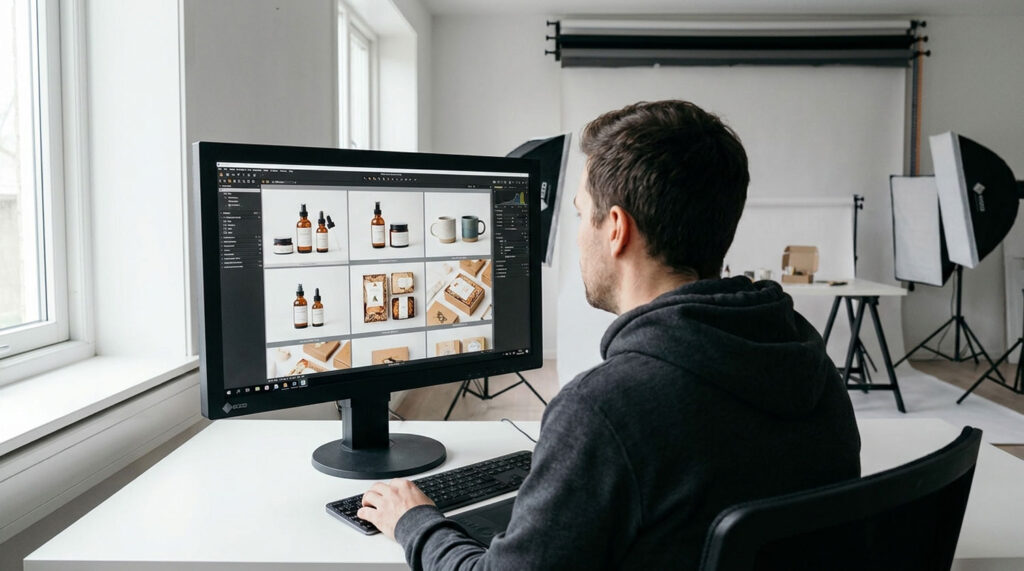
This is the definitive guide to AI product photography UK brands are using in 2026. AI product photography is now a serious option for UK brands, but the gap between using it well and using it badly is wider than most guides acknowledge. This page covers everything you need to know: what AI product photography actually is, what it can and cannot do, what it costs, how platform rules apply, and when you need professional guidance rather than a tool subscription.
We run the UK’s only photographer-led AI visual content consultancy. Everything here is based on working with these tools every day, not on vendor marketing.
What AI Product Photography Actually Is
The term covers a wide range of techniques, and conflating them leads to poor decisions. At one end is simple background removal, an automated edit that has existed for years. At the other is fully generative imagery, where an AI model produces a scene from a text prompt with little or no real product input.
In practice, AI product photography in 2026 tends to fall into four categories:
- Automated editing — background removal, shadow generation, colour correction, upscaling. Fast, reliable, and widely used.
- Compositing — placing a real product photograph into an AI-generated background or lifestyle scene. The product image is real; the environment is synthetic.
- Generative enhancement — using AI to extend, vary, or reframe a real product image. One studio shot becomes multiple crops, angles, or seasonal versions.
- Fully synthetic generation — producing a product image entirely from AI with no studio photography involved. High risk of accuracy failures; best suited to low-fidelity use cases or concept work.
Most serious brands in 2026 operate somewhere in the middle, using real photography as the foundation and AI to generate variation and scale. That hybrid approach is what we work with, and it is the one most likely to produce commercially usable results.
For a practical introduction to getting started without a traditional photoshoot, our guide on how to create professional product images without a photoshoot walks through the process in detail.
What AI Does Well
When it is used correctly and built on quality inputs, AI product photography delivers genuine commercial value. The strongest use cases in 2026 are:
- Lifestyle scene generation — placing a studio-shot product into a contextual environment without a location shoot. Particularly effective for homeware, beauty, and food products where the scene adds purchase intent.
- Catalogue variation — producing multiple colourway, size, or angle variants from a single studio session. Reduces the need for repeat shoots as products evolve.
- Secondary and supporting images — generating the lifestyle, detail, and context shots that sit alongside a hero image in an e-commerce listing.
- Social and campaign content — producing seasonal or campaign-specific imagery quickly without booking studio time for every content cycle.
- Scale — brands with large catalogues can extend a core set of studio images into dozens of variants without the cost of a repeat shoot for every SKU.
The consistent thread across all of these is that AI works best as a multiplier for real photography, not as a replacement for it.
Where AI Falls Short
This is the part most tool vendors skip. Understanding the failure modes before committing budget is the difference between a productive AI workflow and an expensive lesson.
Product fidelity
AI generation systems are pattern-completion engines. They do not have access to the physical product. When given a low-quality source image or asked to generate freely, they will fill in details by inference, and those inferred details are often wrong. Label text shifts. Stitching patterns change. Surface finishes are smoothed or exaggerated. For products where accuracy matters (supplements, apparel, beauty, food), these errors are not cosmetic. They are a compliance and returns risk.
Complex materials
Reflective packaging, transparent glass, fine textures, and metallic finishes all challenge current generation models. These are also exactly the product types where accurate representation is most commercially important. A perfume bottle photographed badly is immediately obvious to a buyer. AI-generated versions of these materials frequently look plausible but wrong in ways that undermine trust.
Consistency across a catalogue
Generating a single strong image from AI is much easier than generating fifty images that maintain consistent lighting, shadow behaviour, product scale, and colour rendition across a full range. Without a controlled workflow and a quality review process, AI-generated catalogues develop visual drift that looks unprofessional at scale.
Our post on why AI product images fail commercially goes deeper on each of these failure modes and what to do about them.
What AI Product Photography Costs in the UK
Costs vary significantly depending on the approach and the quality of output you need. The table below covers the main options for UK brands in 2026.
| Approach | Typical cost | Best for |
|---|---|---|
| DIY tool subscription (Photoroom, Claid, etc.) | £20–£150/month | Background removal, simple edits, small catalogues |
| AI compositing (real product + AI scene) | £50–£200 per image (agency) | Lifestyle content, secondary images, seasonal variation |
| Hybrid studio + AI workflow | £500–£2,000+ per shoot day | Full catalogue production with AI-generated variations |
| AI visual content consultancy | £395–£1,500 for an audit; from £2,000/month retainer | Brands building or fixing an AI visual workflow |
The key variable is how much of the workflow requires human oversight. A tool subscription costs less per month but produces results that may need significant review or correction time. A photographer-led workflow costs more upfront but produces images that are commercially usable without a rework cycle.
For a detailed breakdown of where the real costs sit across a full production cycle, see our guide to product photography costs for UK brands in 2026.
Platform Compliance: What You Need to Know
AI product photography does not exist in a regulation-free space. Three sets of rules are directly relevant to UK brands in 2026.
EU AI Act: Article 50
The EU AI Act’s transparency obligations came into force on 2 August 2026. For brands selling into EU markets, Article 50 requires visible disclosure when AI-generated imagery could be mistaken for a real photograph. This applies to the brand publishing the image, not just the tool provider. AI-generated lifestyle scenes and synthetic model imagery are most likely to require disclosure. Automated background removal is generally outside the scope.
The disclosure obligation sits with you as the deployer. Assuming the tool has handled compliance upstream is not a defence. If you are generating imagery for EU-facing storefronts, this needs to be part of your workflow now.
UK distance selling regulations
The Consumer Contracts Regulations 2013 require that product imagery accurately represents what the consumer will receive. An AI-generated image that misrepresents colour, size, material finish, or product detail creates a returns liability. This applies regardless of how the image was produced.
Marketplace-specific rules
Amazon, Shopify, and most major marketplaces have their own image requirements. Amazon’s main image rules remain strict: white background, product only, no props or added graphics. AI-generated images can meet these requirements if the source input is accurate and the output is reviewed properly. Secondary images have more flexibility. The question is not whether AI is allowed; it is whether the image accurately represents the product. For Amazon sellers specifically, we cover the image slot requirements and compliance risks in detail in our guide to AI product photography for Amazon sellers.
The Hybrid Approach: Why Most Serious Brands Use Both

The most effective AI product photography workflows in 2026 are not fully AI or fully traditional. They use studio photography to create accurate, high-quality product records, then use AI to multiply that investment into lifestyle content, seasonal variations, and catalogue scale.
This approach works because it solves the core problem with each method in isolation. Fully traditional photography is accurate but expensive to scale. Fully AI photography is cheap to scale but prone to the accuracy failures described above. The hybrid model gets accuracy from the studio shoot and scale from AI.
In practice, this means:
- A controlled studio shoot produces clean, accurate product images on a consistent background
- Those studio images are used as the reference input for AI generation
- AI produces lifestyle scenes, colour variants, and supporting content using the studio image as the anchor
- A QA review process checks each output against the original before publication
The photographer’s role in this workflow is not just to take the studio shot. It is to set up the source image correctly for AI generation, brief the generation process, and review the outputs against the product standard. That expertise is what produces consistent, commercially usable results.
Our detailed breakdown of what AI can and cannot do for your product images covers how to assess which approach suits your catalogue and budget.
AI Product Photography Quality: How to Judge the Output
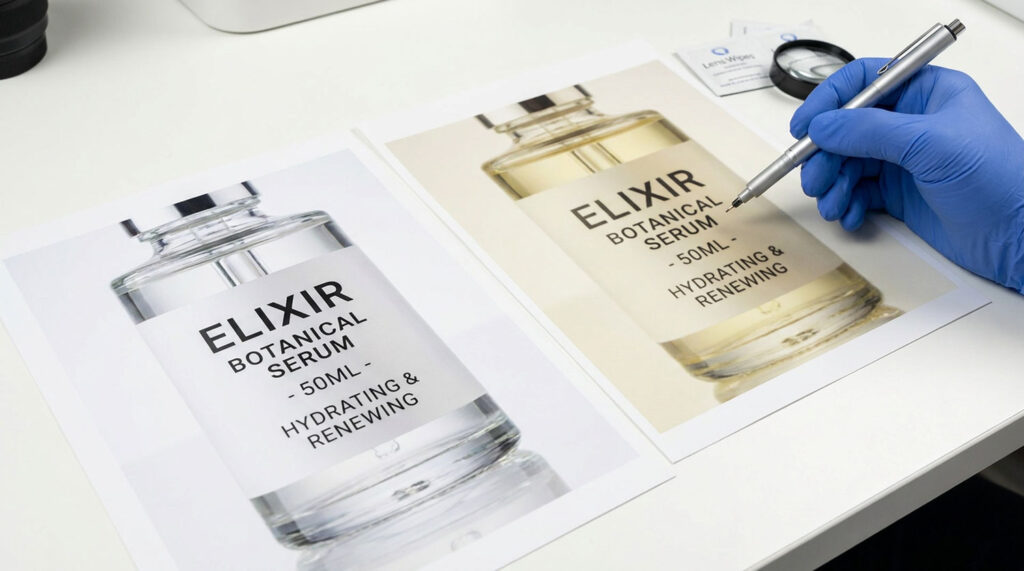
Not all AI-generated images fail in obvious ways. The failures that cause commercial problems are often the subtle ones: a label that reads slightly differently, a surface finish that is a tone too warm, a product that looks slightly larger than it is. These pass a quick visual check and fail when a customer receives the product and compares it to what they bought.
A quality review process for AI product photography should check:
- Colour accuracy against a calibrated reference (not a monitor)
- Label and text legibility and accuracy
- Surface finish and texture consistency with the physical product
- Scale and proportion relative to props or scene elements
- Platform compliance for every channel the image will appear on
This is not a process a generation tool automates. It requires someone who knows what the product looks like and can compare the image to the standard. For brands building a high-volume AI workflow, this review step is the most commonly underestimated part of the cost and time budget.
For more on where quality failures happen and how to avoid them, see our post on why AI product images fail commercially.
Do You Need a Consultant, or Can You Do It Yourself?
The honest answer depends on the scale of your catalogue, the complexity of your products, and how much internal resource you have to manage a QA process.
DIY tool subscriptions work well for brands with straightforward products, small catalogues, and flexible image standards: social content, blog imagery, concept visuals. The tools are improving quickly and the entry cost is low.
Professional guidance makes sense when:
- You have a large catalogue and need consistent results across hundreds or thousands of SKUs
- Your products have complex materials, precise colours, or regulatory labelling requirements
- You are selling into regulated markets and need a workflow that is documented and defensible
- You have tried AI tools and are not getting commercially usable results
- You want to build an internal capability that your team can run without ongoing agency dependency
An AI Visual Content Audit is typically the right starting point. It reviews your current imagery across all platforms, identifies where AI could add value, assesses compliance risk, and gives you a clear picture of what a better workflow would look like before you commit budget to building one.
Getting Started with AI Product Photography in the UK
If you are starting from scratch, the most common mistake is beginning with the tool rather than the brief. What you need to define first:
- Which product types and SKUs you are prioritising
- What platforms the images need to work on (and their specific requirements)
- What your existing studio or source image quality looks like
- What your internal QA capacity is for reviewing outputs
- Whether you have compliance obligations that affect how images are produced or labelled
With those questions answered, tool selection and workflow design become much more straightforward. Without them, you are likely to spend time and budget on a setup that does not produce the results your listings or campaigns actually need.
Work With Us

We offer two entry points depending on where you are in the process.
If you want to understand what AI product photography could do for your brand before committing to a workflow, a Visual Content Audit (£1,500 +VAT) reviews your current imagery, benchmarks it against competitors, assesses AI readiness across your catalogue, and delivers a clear action plan. It takes seven working days and includes a video walkthrough of the findings.
If you already know what you need and want to get on with building it, get in touch directly and we will scope it from there.
Get in touch to discuss your project
Frequently Asked Questions
Is AI product photography legal in the UK?
Yes. There is no UK law that prohibits AI-generated product imagery. The relevant obligations are accuracy (Consumer Contracts Regulations 2013 require images to represent what the customer will receive), platform compliance (Amazon, Shopify, and others have their own image rules), and, for brands selling into EU markets, disclosure under Article 50 of the EU AI Act. None of these prohibit AI imagery. They set standards for how it is used and labelled.
Will Amazon allow AI product photography?
Amazon does not prohibit AI product photography. The main image requirements apply regardless of how the image was produced: white background, product only, accurate representation. AI-generated images that meet these requirements are acceptable. The risk is not the use of AI; it is inaccurate product representation, which is prohibited whether the image was AI-generated or not. Secondary images have more flexibility and are well-suited to AI-generated lifestyle content.
How much does AI product photography cost in the UK?
Tool subscriptions start from around £20 to £150 per month for DIY platforms. Agency-produced AI compositing typically runs from £50 to £200 per image depending on complexity. A full hybrid workflow (studio shoot plus AI-generated variations) sits in the range of £500 to £2,000 or more per shoot day depending on volume and product complexity. Consultancy and audit services start from £395 for a listing review and £1,500 for a full Visual Content Audit.
What products work best with AI photography?
Products with clean, defined shapes and consistent surfaces tend to produce the best AI-generated results. Homeware, packaged food and drink, beauty products with clear packaging, and apparel all work well in a properly managed hybrid workflow. Products with complex reflective surfaces (glass, mirrors, polished metals), fine fabric textures, or regulatory label requirements need more careful management and a stronger studio foundation before AI generation adds value.
Do I need to disclose that my images are AI-generated?
For brands selling into EU markets, the EU AI Act’s Article 50 transparency obligations now apply (from 2 August 2026). Visible disclosure is required for AI-generated images that could be mistaken for real photographs. This includes AI-generated lifestyle scenes and synthetic model imagery. The obligation sits with the brand publishing the image. For UK-only sales, there is currently no equivalent statutory disclosure requirement, though platform-specific rules may apply.
What is a photographer-led AI workflow?
A photographer-led AI workflow uses studio photography as the foundation and AI generation as the scale layer. A controlled studio shoot produces accurate, high-quality product records. Those images feed into AI generation to produce lifestyle scenes, colour variations, and supporting content. A photographer or visual specialist sets up the source images correctly, briefs the generation process, and reviews the outputs against the product standard before publication. The result is imagery that has AI’s speed and scale advantages without the accuracy failures that come from fully generative approaches.