AI product photography quality problems rarely look like the dramatic failures people expect warped hands, melting faces, obvious glitches. The images that actually damage brands are the ones that look fine at a glance but fail commercially: a logo that’s slightly off, a colour that doesn’t match the physical product, a lifestyle scene that platforms flag as misleading. Those failures are subtler, costlier, and far more common than most brands realise until a listing gets suppressed or a customer complains that what arrived looked nothing like the photo.
We work with brands that come to us after attempting AI product photography in-house and hitting a wall they couldn’t diagnose. The images weren’t obviously wrong. They just weren’t working lower conversion rates, returns ticking up, inconsistency across a catalogue that had previously looked cohesive. This article covers the real reasons AI product photography quality falls short, most of which have nothing to do with the AI tools themselves, and what a reliable production process actually looks like.
The difference between a technically correct image and one that sells
Most AI image quality guides focus on technical output: resolution, pixel dimensions, artefacts, whether the upscaling held detail. Those things matter, but they’re not where brands lose money. An image can be technically flawless sharp, well-resolved, artifact-free and still kill conversion.
The commercial standard for product photography is different from the technical standard. A buyer who can’t touch, smell, or try your product relies entirely on the image to make a purchasing decision. What they need from that image is confidence: that the colour is accurate, that the scale is readable, that the product they receive will match what they’re looking at. An AI image that passes a technical quality check but creates false expectations is worse than a mediocre photograph. The mediocre photograph at least shows the real product.
The question to ask of any AI-generated product image is not “does this look good?” but “does this accurately represent what the customer will receive?” That distinction drives every quality decision worth making in an AI product photography workflow.
The product fidelity problem
Product fidelity is the most commercially significant AI product photography quality failure mode, and it’s where brands with existing visual assets get caught out most often. It refers to how accurately an AI-generated image represents the actual product and specifically, whether the logo, label, colour, shape, and material details survive the generation process intact.
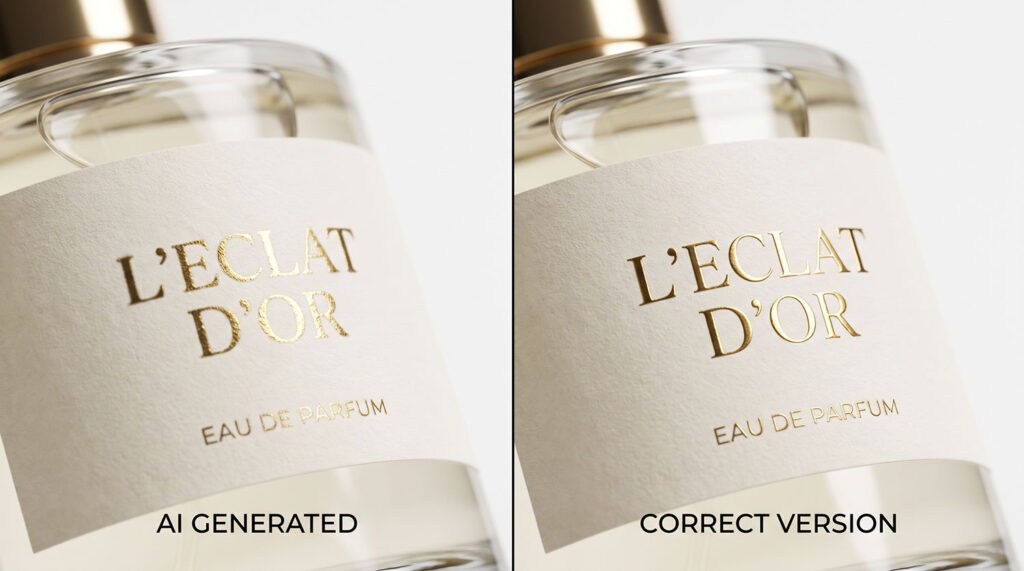
The short answer is that they often don’t. Here’s what product fidelity failure looks like in practice:
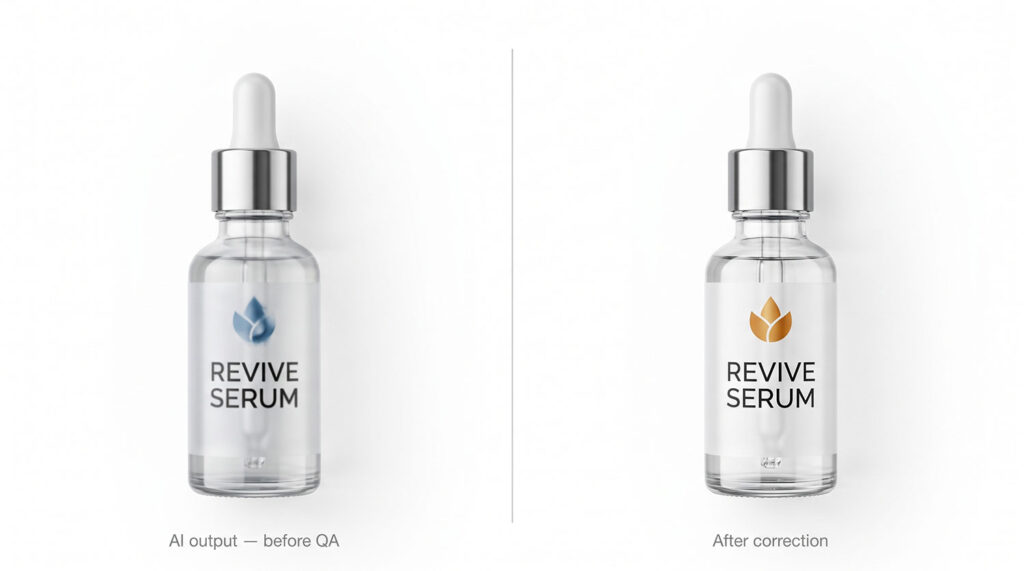
- Logo drift: The brand logo is present but subtly distorted letterforms shift, spacing changes, a registered trademark symbol disappears. Looks fine at thumbnail size. Fails when a customer zooms in on a product detail page, or when a retail partner runs it through their image quality check.
- Colour inaccuracy: AI generation tends to interpret colours rather than reproduce them. A Pantone-matched navy becomes dark blue. A warm ivory shifts cream. For fashion, homeware, and beauty brands where exact colour accuracy drives purchasing decisions, this is a returns problem.
- Label illegibility: Text on product labels ingredients lists, size information, care instructions frequently collapses into plausible-looking but unreadable detail. Fine for lifestyle imagery. A compliance issue for regulated product categories.
- Material misrepresentation: AI can render the suggestion of a texture brushed metal, matte ceramic, woven fabric without reproducing how that material actually behaves in light. The result looks like the product category but not necessarily like your product.
- Shape distortion: Subtle geometry changes are common, particularly on products with distinctive silhouettes. A perfume bottle with a proprietary curved form may come back slightly more generic than the original.
These failures are not random. They’re predictable given how AI image generation works: the model is producing a plausible version of what it understands the image to show, not a precise reproduction of the source material. Working with that constraint rather than against it is what separates a reliable AI product photography workflow from a lottery.
When the input is the problem, not the AI
A significant proportion of AI product photography quality failures are input failures. The AI gets blamed; the real culprit is what went into the generation process in the first place.
The reference image is the single biggest variable in any AI product photography workflow. A low-resolution source image, a poorly lit original photograph, a JPEG that’s been compressed multiple times these become the foundation the AI builds from. Garbage in, garbage out remains as true here as it does anywhere in visual production.
Specifically, inputs that reliably produce poor AI product photography output include:
- Source images under 1000px on the longest side insufficient detail for the AI to work from
- Images with inconsistent or mixed lighting in the original, which the AI compounds rather than corrects
- Background-heavy originals where the product is a relatively small part of the frame
- Already-compressed web images used as reference rather than original export files
- Multiple reference images with inconsistent colour grading, confusing the model about what the product actually looks like
The fix here is upstream of any AI tool: establishing what constitutes an acceptable reference image before production begins. Brands that treat their existing product photography as a ready-made library for AI generation often discover it was never captured with that use in mind. A product shot on a white background for a 2019 catalogue, saved as a web JPEG, is not a sound foundation for AI lifestyle generation at catalogue scale. UK consumer distance selling regulations require that products are accurately described and represented which makes image accuracy a legal question as much as a quality one.
This is also why we run a Visual Content Audit as the entry point for client engagements rather than going straight to production. Before any AI generation happens, we need to know what we’re working from.
Platform and channel requirements AI images often miss
Beyond brand and quality concerns, AI product images have to meet the image standards of wherever they’re being used and those standards vary considerably between channels. Getting this wrong doesn’t just produce a bad image; it produces a rejected ad, a disapproved product feed, a suppressed listing, or a compliance issue with a retail partner.
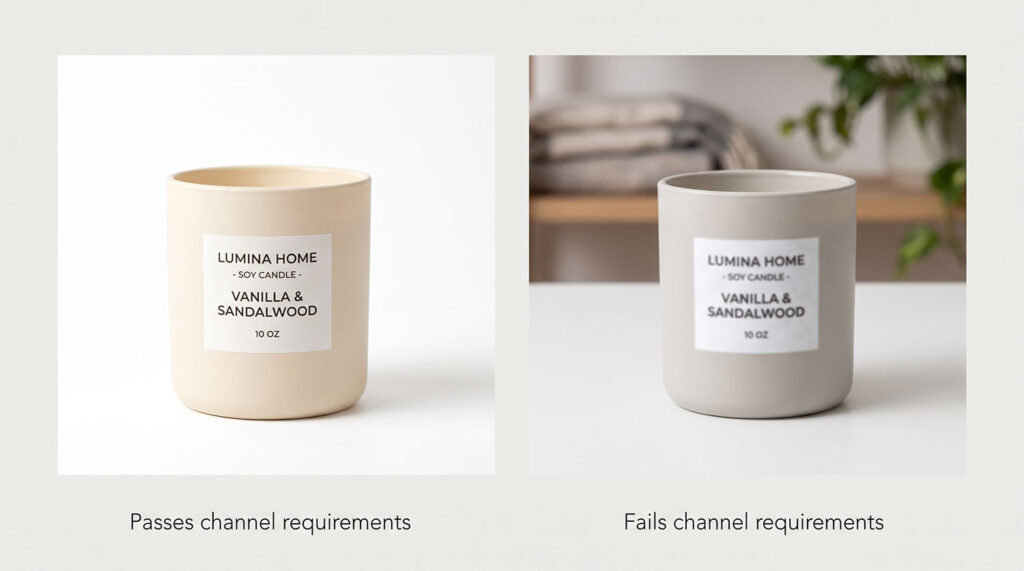
The requirements themselves aren’t new, but they’re being enforced more rigorously as AI-generated content becomes more common. Here’s how the most frequent failure points break down by channel:
| Channel | Key requirement | Common AI failure point |
|---|---|---|
| E-commerce listings (all platforms) | Primary product image must accurately represent the item correct colour, dimensions, and features | Colour drift, shape distortion, or invented product details that don’t match the physical product |
| Paid social (Meta, TikTok) | AI-generated or significantly AI-edited creative requires disclosure labelling in many markets | Untagged AI-generated lifestyle scenes submitted as ad creative |
| Google Shopping | Images must match the product accurately; misleading images trigger disapproval and feed suspension | AI lifestyle imagery used as the primary product image rather than an accurate product shot |
| Retail partner portals | Brand style guides typically specify background colour, image ratio, colour profile, and file format | AI-generated images that approximate the spec rather than meeting it exactly |
| EU markets (all channels) | EU AI Act Article 50 disclosure obligations on AI-generated content apply from August 2026 | No disclosure workflow in place for brands selling into EU markets |
The thread running through all of these is accuracy. Platforms and retailers are not particularly concerned with how an image was produced what they require is that images truthfully represent the product and meet the channel’s technical specifications. AI images that fail on either count create the same problems as any other non-compliant image, just potentially at greater volume if the failure is baked into the production workflow.
The practical implication: channel requirements need to be part of the brief before generation begins, not a checklist applied afterwards. An image generated without knowing it needs to meet a retail partner’s exact colour profile or a paid social platform’s disclosure requirements will need reworking or rejection.
How to QA AI product photography quality before it goes live
A structured QA process is what separates high AI product photography quality at scale from AI product photography that creates problems at scale. The checks below should happen before any AI-generated image is published to a product listing, ad creative, or website.
Run through this sequence on every batch:
- Product accuracy check: Place the physical product next to the screen. Compare colour, shape, label, and material. If there’s visible divergence, the image fails regardless of how good it looks in isolation.
- Text legibility check: Zoom to 200% and read any text that appears on the product. If label text is blurred, distorted, or illegible, reject the image for listing use (it may still work for brand lifestyle content with no text).
- Brand mark check: Verify the logo against brand guidelines letterforms, spacing, colour values. Logo drift is easiest to miss when you’re reviewing at speed across a large catalogue.
- Colour profile check: Where exact colour accuracy matters (fashion, beauty, paint, homeware), verify against a calibrated reference. Screen colour profiles vary; what looks accurate on one display may not be on another.
- Channel spec check: Verify dimensions, file size, format, and background against the requirements of every channel the image will appear on. The same image destined for a retail partner portal, a Google Shopping feed, and a paid social ad may need three different treatments.
- Compliance metadata check: For AI images featuring people, confirm required metadata fields are populated before upload.
This is not a quick process when done properly. A QA pass on a batch of 50 AI-generated images from a single SKU launch takes meaningful time. That’s appropriate: the cost of a suppressed listing or a returns spike is higher than the cost of a thorough QA process.
If you’re finding QA is taking longer than production, that’s usually a signal that the production inputs need tightening better reference images, cleaner brief, tighter prompt discipline rather than that QA should be shortened.
Not sure where your current imagery sits against these standards? An Visual Content Audit gives you a clear picture of what’s working, what’s creating risk, and where AI can be introduced safely into your production workflow.
The hybrid approach: where AI product photography actually delivers
The brands getting consistent, commercially reliable results from AI product photography are not replacing photography with AI. They’re using a hybrid model: real photography for the images that require exact product accuracy main listing images, hero shots, close-up detail and AI generation for the content that benefits from speed and scale: lifestyle scenes, seasonal variants, platform-specific crops, A/B test creative.
This is not a compromise position. It’s the correct architecture for AI in a product photography workflow, because it puts each tool where its strengths actually lie. Photography gives you the accurate, fidelity-checked base image that platforms require and customers trust. AI gives you the ability to extend that asset into dozens of contexts at a fraction of the cost of re-shooting.
The common failure is treating AI as a complete replacement for photography rather than as an extension of it. That’s where product fidelity breaks down, where compliance risk creeps in, and where the catalogue starts to look inconsistent.
For more on what AI can and can’t do reliably in a product photography context, see our earlier post on what AI can and can’t do for your product images in 2026.
Start with what you already have
Most brands sitting on a library of existing product photography can start getting value from AI visual content faster than they expect provided the existing assets are in reasonable shape. The typical starting point is an audit of what’s there: what quality the reference images are, which products have enough visual coverage to support AI extension, and which need a reshoots before AI generation is viable.
If you’re considering AI product photography for your catalogue or trying to understand why your AI product photography quality isn’t where it needs to be our Visual Content Audit is the right starting point. We review your current imagery across all relevant platforms, identify where the quality and compliance gaps are, and give you a clear picture of what a reliable AI production workflow looks like for your specific product range.
No production commitments required. The audit stands alone as a deliverable: a report and 60-minute video walkthrough, delivered within seven working days.
Find out more about the Visual Content Audit →
Frequently Asked Questions
Why do my AI product images look different from the actual product?
AI generation produces a plausible interpretation of your product based on the reference images provided it doesn’t reproduce the product with photographic precision. Colour drift, subtle shape changes, and logo distortion are the most common divergences. The fix is usually a combination of higher-quality reference images and a structured QA process that compares output to the physical product before anything is published.
Are AI-generated product images accepted by e-commerce platforms and retailers?
Generally yes most platforms and retail partners are indifferent to how an image was produced, provided it meets their accuracy and technical requirements. The compliance risk isn’t using AI; it’s using AI images that misrepresent the product or fail to meet channel specifications. Where disclosure requirements apply paid social platforms, EU markets under AI Act obligations from August 2026 those need to be built into the production workflow rather than handled case by case.
What is product fidelity in AI product photography?
Product fidelity refers to how accurately an AI-generated image represents the actual physical product. High AI product photography quality means the logo, label, colour, shape, and material details match what a customer will receive. Low fidelity means the AI has introduced divergences however subtle that create a gap between the image and the product. For e-commerce brands, low fidelity is both a conversion risk (customers sense something is slightly off) and a returns risk (customers receive something that doesn’t match the image).
Do I need real photography if I’m using AI for product images?
For most product categories, yes. The most reliable AI product photography workflows use real photography for the images that require exact product accuracy main listing images, detail shots, images where colour and material fidelity matter and AI generation for lifestyle scenes, seasonal variants, and platform-specific creative. Using AI to generate product listing images without a real photography foundation is where accuracy and compliance problems most commonly arise.
How do I know if my existing AI product images are compliant?
Compliance covers several distinct areas: product accuracy (does the image match the physical product?), technical specs (dimensions, file format, background colour which vary by channel), disclosure requirements (paid social platforms and EU markets under AI Act Article 50 from August 2026), and retail partner style guide requirements. A Visual Content Audit reviews your existing imagery against all relevant channel requirements and flags specific compliance gaps before they become live problems.
What’s the most common reason AI product photography fails for e-commerce brands?
Poor input quality is the most common AI product photography quality failure low-resolution reference images, compressed originals, inconsistent source photography. The AI amplifies existing problems in source material rather than correcting them. The second most common cause is missing QA: images that were never properly checked against the physical product before going live. Both are process failures rather than AI failures, which means they’re fixable with the right production workflow in place.
Written by Dee, founder of Products Photography.AI. Dee has 14 years of commercial photography experience working with UK e-commerce brands across fashion, beauty, homeware, and toys. She leads AI visual content production and consultancy, helping brands build reliable AI image workflows that meet platform compliance requirements and convert.

Dee Patel is an AI Visual Content Consultant and commercial product photographer with 14 years of experience. Dee advises UK e-commerce brands, retail businesses, and creative agencies on AI visual content strategy, production workflows, and cost efficiency. Based in the West Midlands.