

There is no shortage of opinions about AI product photography. At one end, you have the tools and platforms telling you that studio photography is dead, that AI can produce anything you need in seconds, and that professional photographers are an unnecessary expense. At the other end, you have traditional studios arguing that AI produces unrealistic images that damage brands and mislead buyers.
Understanding the AI product photography pros and cons properly is more useful than either position.
Neither position is particularly useful if you are trying to make a sensible decision about how to produce visual content for your business.
The reality is more straightforward. AI product photography has matured significantly over the past couple of years, and it is genuinely useful for a wide range of applications. It also has real limitations, limitations that are not going away any time soon and understanding where those boundaries sit is the difference between building a workflow that works and spending money on output you cannot use.
This is the honest version of that conversation.
What AI Does Well
Used correctly, AI is a powerful tool for product image production. These are the areas where it consistently delivers.
Lifestyle scene generation
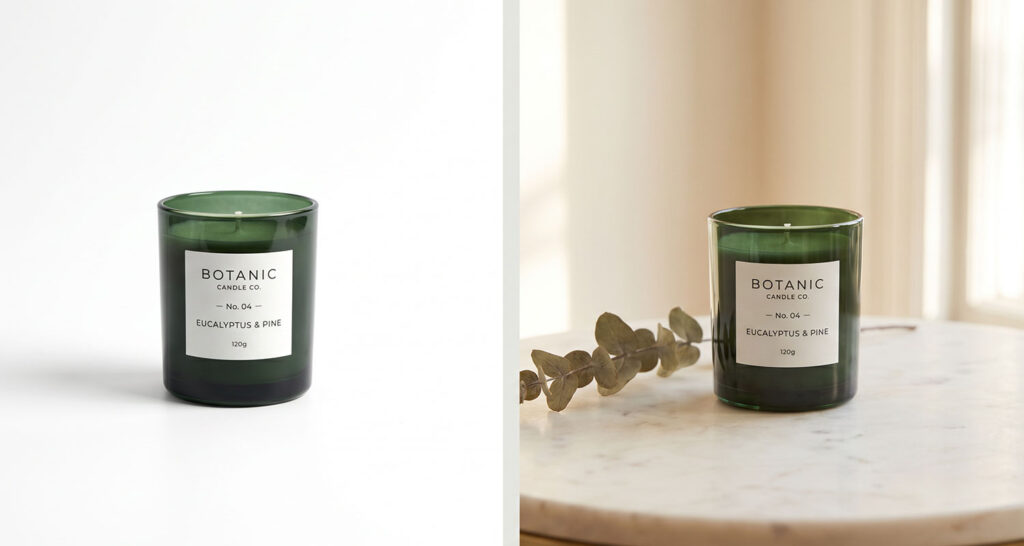
Taking a clean product shot and placing it into a realistic lifestyle environment, a kitchen counter, a bathroom shelf, an outdoor table setting, is something AI handles well. What would once have required a location scout, a set build, and a full production day can now be achieved from a single reference image. The quality, when the workflow is properly structured, is indistinguishable from location photography for most secondary and supporting imagery.
The practical implication for brands is significant. A single hero photograph of a product can now become the source for a kitchen scene, a dining room scene, an outdoor entertaining scene, and a flat lay, all in a fraction of the time and cost of individual location shoots. For brands selling across multiple lifestyle contexts, or wanting to speak to different customer segments with different visual environments, this is a genuine step change.
Volume and variants
AI is particularly strong where traditional photography struggles most: scale. If you need a product shown across multiple environments, in multiple seasonal contexts, or adapted for different platforms and formats, AI removes the bottleneck almost entirely. A single well-executed product shot can become the foundation for dozens of derivative images without additional shoots.
This matters practically for brands managing large catalogues. Traditional photography becomes exponentially harder to scale as SKU counts grow, more samples to move, more studio time to book, more post-production to manage. AI does not have those constraints. The same workflow that handles ten products handles a hundred. For seasonal refreshes, platform-specific crops, or A/B testing different visual treatments, the speed advantage compounds quickly.
Background removal and replacement
Background work, removing, replacing, or generating clean studio-style backgrounds, is where AI tools are most mature and most reliable. For catalogue images requiring consistent white or neutral backgrounds, the results are fast and accurate. For generating contextual backgrounds that place a product in a specific setting without a full lifestyle shoot, the quality has improved significantly over the past two years.
This is no longer a differentiator in itself, it is table stakes. The more interesting application is using background generation as the foundation for lifestyle imagery: rather than starting from scratch, a well-isolated product image becomes the input for an AI-generated scene that looks and feels like location photography.
Speed and cost for supporting content
For the secondary images in a product listing, the lifestyle context shots, the detail environments, the seasonal refreshes, AI dramatically reduces both cost and turnaround time. Brands that previously had to plan and budget for multiple shoots per year can now generate supporting content on an ongoing basis without the same financial commitment.
To put some context around the economics: a traditional lifestyle shoot involving location, crew, props, and post-production might cost several thousand pounds and take three to four weeks from brief to delivery. An equivalent set of AI-generated lifestyle images, built on existing photography, can be produced in a matter of days at a fraction of that cost. For brands that need to refresh content regularly, seasonal campaigns, new market launches, platform-specific creative, that difference compounds over the course of a year into a meaningful budget saving.
The AI Product Photography Pros and Cons: Where It Still Falls Short
This is the section most AI tool providers would rather you did not read too carefully.
Reflective, transparent, and textured materials
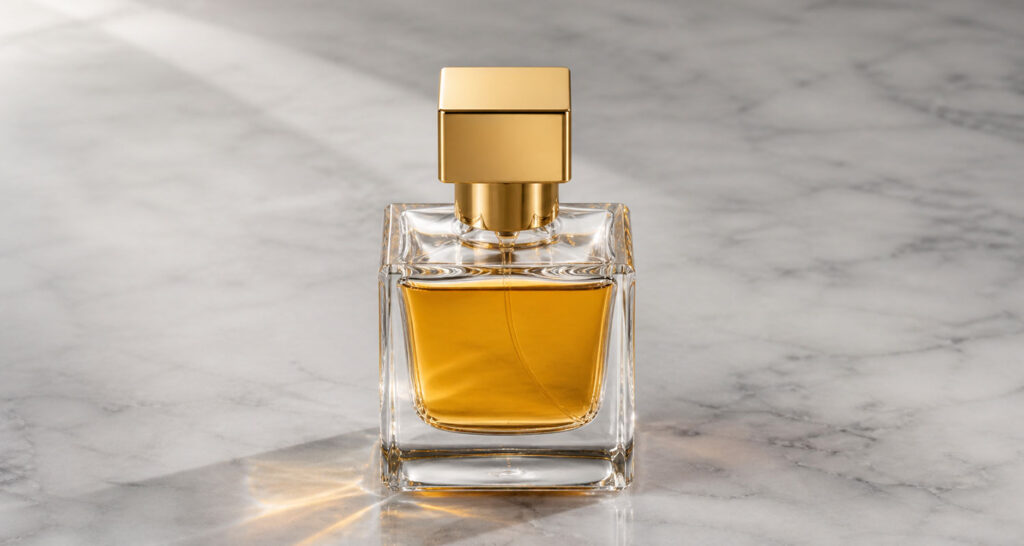
Glass, foil packaging, polished metal, transparent containers, complex fabric weaves, these are consistently the most difficult product categories for AI to handle convincingly. The physics of how light interacts with these materials is hard to simulate accurately, and the results often look slightly wrong in ways that are difficult to articulate but immediately noticeable to buyers.
The problem is specific. A glass bottle, for example, should show the environment behind it through the body of the glass, cast a particular quality of refracted light on the surface beneath it, and reflect its surroundings in a physically coherent way. AI-generated glass tends to look opaque where it should be transparent, or transparent where the physics suggest it should reflect. Foil packaging presents similar challenges, the crinkle and sheen that reads as premium on a studio shot becomes flat or unconvincing when generated. If your product relies on material quality as a selling point, AI-generated primary images carry real risk.
Colour accuracy
For categories where exact colour is a purchasing decision, cosmetics, paint, fabric, stationery, AI introduces variability that traditional photography does not. Even with strong reference images, colour can shift subtly across generations. The shift is often small: a warm red that pulls slightly orange, a muted green that loses its grey undertone. Small enough that it might not be caught in a quick review, but significant enough that a buyer who purchases based on that image and receives something that looks different will return the product.
For a skincare brand where the shade of a foundation needs to match what a customer sees on screen, or a homeware brand where a buyer is colour-matching to a room they are decorating, that variability is simply not acceptable in hero imagery. Colour management in a controlled studio environment, calibrated lighting, consistent white balance, proper colour grading, eliminates this problem. AI, at present, cannot reliably replicate it.
Catalogue consistency at scale
AI can produce excellent individual images. The harder challenge is producing fifty or a hundred images that feel like they belong to the same brand, same tonal range, same shadow quality, same sense of light, same compositional logic. Without a structured, disciplined workflow built around consistent inputs and outputs, visual drift across a catalogue is almost inevitable.
This matters commercially. Research from Lucidpress found that
consistent brand presentation across channels drives around a 23% revenue increase. The implication for AI workflows is significant: brands using AI without proper consistency controls can actually undermine conversion despite reducing production costs. A product range that looks like it was shot by different people in different conditions, even if it was actually generated by the same tool, erodes the sense of quality and coherence that buyers associate with trustworthy brands.
Hero images and luxury positioning
For the lead image on a product detail page, the image a buyer sees first and that carries the most weight in the purchase decision, AI-generated imagery is still not the right choice for most premium and luxury products. The tactile quality, the intentional lighting, the precise art direction that communicates value: these are things a skilled photographer engineers deliberately in a controlled environment. Every shadow, every highlight, every reflection is a decision.
AI can approximate the look of a well-lit studio image. But buyers who are spending significant money on a product are sensitive to the difference between an image that communicates considered craftsmanship and one that merely looks acceptable. Premium positioning is built on details, and details are where AI workflows still require the most human oversight.
The input problem
This is the one most brands miss entirely, and it is arguably the most important limitation of all. AI does not correct poor photography, it amplifies it. If the starting image has inconsistent lighting, colour casts, soft focus, or edge definition problems, those issues carry through into every AI output and often become more pronounced at scale.
Think of it this way: AI is a production engine, not a correction tool. Feed it a strong, clean, well-executed photograph and it will generate strong, consistent derivative content. Feed it a mediocre image and it will generate mediocre content at volume. This is why brands that invest in quality photography before adding AI to their workflow consistently outperform those that try to use AI to compensate for weak source material and it is one of the most common reasons why AI product images fail commercially.
The Compliance Risk Most Brands Are Not Thinking About
Marketplace platforms are increasingly introducing AI image detection and disclosure requirements, and the rules are not yet consistent or well-understood. This is an area where the gap between what brands are doing and what platforms are starting to require is widening quickly.
Disclosure requirements are tightening
Several major e-commerce platforms now require sellers to indicate when product images have been substantially generated or altered using AI. The definition of “substantial” varies by platform and is still evolving, background replacement might be treated differently from a fully AI-generated scene, and minimal enhancements like brightness correction are generally treated differently from generative content. The policies are moving targets, and brands using AI-generated imagery without actively monitoring current platform requirements are carrying compliance risk they may not be aware of.
The more immediate concern is accuracy. Every major marketplace has existing rules requiring that product images accurately represent what a buyer will receive. AI-generated imagery that misrepresents colour, dimensions, material finish, or product detail, even unintentionally, falls foul of those rules regardless of how the image was produced. This is not a new risk created by AI; it is an existing risk that AI workflows can make easier to accidentally breach.
Detection tools create their own problem
AI image detection is still an imperfect science, and false positives are a genuine commercial risk. Automated detection systems used by some platforms flag images based on artefact signatures, the tell-tale marks left by AI generation tools in areas like edges, shadows, reflections, and fine detail. Images that are legitimately compliant can be flagged and listings suppressed without clear explanation, leaving sellers in the frustrating position of having to prove a negative.
The sellers most at risk are those using lower-quality AI outputs built on weak source photography. Poor inputs produce outputs with more visible artefacts, the very signatures that detection systems look for. A clean, well-executed AI workflow built on strong photography produces images that are both better quality and less likely to trigger false positives. For Amazon sellers, we cover the specific image slot requirements and listing suppression risks in detail in our guide to AI product photography for Amazon sellers.
The practical implication is straightforward: AI-generated imagery needs to be clean, artefact-free, and built on a strong photographic foundation, not just to look good to buyers, but to move through marketplace compliance systems without friction.
Where Traditional Photography and AI Work Best Together
The most effective approach in 2026 is not a choice between AI and traditional photography. It is a workflow that uses both deliberately, with each doing what it does best.
Think in terms of image purpose, not image type
A useful framework is to categorise your images by the job they need to do rather than how they were produced. Hero images, the primary product detail page image, the lead creative for paid media, the imagery that carries the most brand weight, need to do the heaviest lifting. They need to communicate product accuracy, build trust, and withstand close scrutiny from a buyer who is genuinely considering a purchase. For these, traditional photography in a controlled studio environment remains the stronger choice.
Supporting content, lifestyle contexts, platform-specific variants, seasonal refreshes, secondary gallery images, social media adaptations, does a different job. It adds context, demonstrates use, and gives buyers a sense of how the product fits into their life. These images need to be visually consistent with the hero imagery, but they do not need to carry the same weight or withstand the same level of scrutiny. This is where AI delivers the most value: producing a wide range of credible, on-brand supporting imagery quickly and cost-effectively from a strong photographic foundation.
Why the photography foundation matters more than most brands realise
The photographer-led advantage in this hybrid model is not just about having better hero shots. It is about what good photography makes possible downstream.
When hero photography is executed to a high standard, controlled, consistent lighting; accurate, managed colour; clean, well-defined edges, AI has a reliable and stable foundation to build from. The output is stronger, the consistency across a catalogue is easier to maintain, and the risk of the artefacts and colour drift that cause compliance problems is significantly reduced.
Conversely, when the starting photography is weak, inconsistent between products, poorly lit, colour-uncalibrated, AI compounds rather than corrects those problems. Every issue in the source material becomes visible across every derivative image. The studio shoot, done properly, stops being a cost and becomes a long-term production asset: a single investment that keeps generating usable content over time.
A practical split to work from
As a starting point, consider using traditional photography for roughly 20 to 30% of your total image output, specifically the images doing the heaviest commercial work and AI to generate the remaining 70 to 80%, always built on that photographic foundation. The exact ratio will depend on your product category, your platform mix, and how much of your imagery is hero versus supporting content. But the principle holds across most e-commerce contexts: photography sets the standard, AI scales the output. If you are looking for a practical starting point, our guide on how to create professional product images without a photoshoot covers the workflow step by step.
Frequently Asked Questions
What are the main AI product photography pros and cons for e-commerce brands?
For most brands, no, not if you care about hero image quality, colour accuracy, and brand consistency. AI is most effective as a production layer built on top of professional photography, not a replacement for it. That said, for certain product categories and use cases (simple backgrounds, lifestyle variants for secondary gallery slots), AI-only workflows can work well when they are properly structured.
Which product categories work best with AI imagery?
Homeware, lifestyle accessories, dry food and packaging, stationery, and simple apparel tend to produce the strongest AI results. Categories that present more difficulty include reflective and transparent products (glass, bottles, foil), textiles where fabric drape and texture are a selling point, and luxury goods where the perception of quality is tied directly to the imagery.
Does AI product photography work for premium or luxury brands?
With care, and in the right applications. Lifestyle and editorial imagery for premium brands can be produced effectively using AI when it is built on high-quality photography and managed with a structured creative brief. For hero imagery on luxury products, traditional photography remains the stronger choice, the precision and intentionality of a controlled studio shoot is hard to replicate convincingly at the level these brands require.
What do I need before I can use AI for my product images?
A clean, well-lit photograph of your product is the non-negotiable starting point. Ideally shot on a plain background with controlled lighting, accurate colour, and sharp edges. The better the photography going in, the better the AI output coming out. If your existing product imagery is inconsistent or low quality, the first step is addressing that, not adding AI on top of it.
The Bottom Line
AI has earned its place in product image production. The economics are compelling, the quality for supporting content is consistently strong, and the speed advantage for volume production is real.
It also has genuine limitations that are worth understanding before you commit budget and time. The brands and sellers getting the best results in 2026 are not those who have replaced their photography budgets with AI subscriptions. They are the ones who have built workflows that use professional photography as the foundation and AI as the production engine, getting the quality of the former and the scale and speed of the latter.
The AI product photography pros and cons covered in this post point to the same conclusion. If you want to understand exactly what an AI visual content audit involves before booking one, we cover it in detail here.
For a full breakdown of what AI product photography involves, what it costs, and how to approach it as a UK brand, our complete guide to AI product photography UK is the right starting point.
If you are not sure where AI fits into your current visual content workflow, or whether what you are doing now is set up to make the most of it, that is a straightforward question to answer with the right review. Our Visual Content Audit is designed to do exactly that, a clear-eyed assessment of what you have, what is possible, and where the gaps are.

Dee Patel is an AI Visual Content Consultant and commercial product photographer with 14 years of experience. Dee advises UK e-commerce brands, retail businesses, and creative agencies on AI visual content strategy, production workflows, and cost efficiency. Based in the West Midlands.